When I was 18, I worked part-time in the Medicinal Chemistry Dept of the university I attended. During that school year, I created a library for a professor whom I worked for who studied bees. I read science articles for him, identified key terms he specified, and made note cards of any findings related to those terms. Who knew I would become fascinated by the research the department worked on, which was vast, ranging from bees to biopolymer research. One day, my boss told me that his daughter was going to a gardening school in New York and gave me a brochure. I looked it over and realized that it was so far away and cost a lot of money, but I always dreamt of attending a school like that and, one day, becoming an herbalist.
After the school year ended, I went home to the Navajo reservation for the summer and interned at a local shelter home. Every now and then, I visited my nali lady Thora and took my little voice recorder with me. I would ask her questions about the plants I helped her gather, and she would get after me, telling me I needed to learn Navajo and that it would be easier for her to teach me if I could speak Navajo. Nevertheless, I think I was good company, and I would make her laugh, carrying that recorder, sounding out names like a broken speaker.
I loved visiting her because she would tell me stories about my dad, whom I barely remembered. After all, he died of cancer when I was 6 years old. What I do remember is watering our backyard plants and more plants at our community garden. I remember him saying that if the soil is good, we can grow anything. I would later learn that the community that I grew up in was next to an abandoned uranium mine, and that was also what caused my dad’s cancer because he used to work in a nearby uranium mill when he was a young adult.
But enough of that. I’m 46 now and sitting in the back room of my home, surrounded by boxes of seeds that I am cataloging, running seed viability tests, and starting seeds indoors and outside in my backyard garden. These seeds were given to my partner and me by a dear friend who died a few years ago, and I want to continue her work, learn more about seed saving, and start writing again.
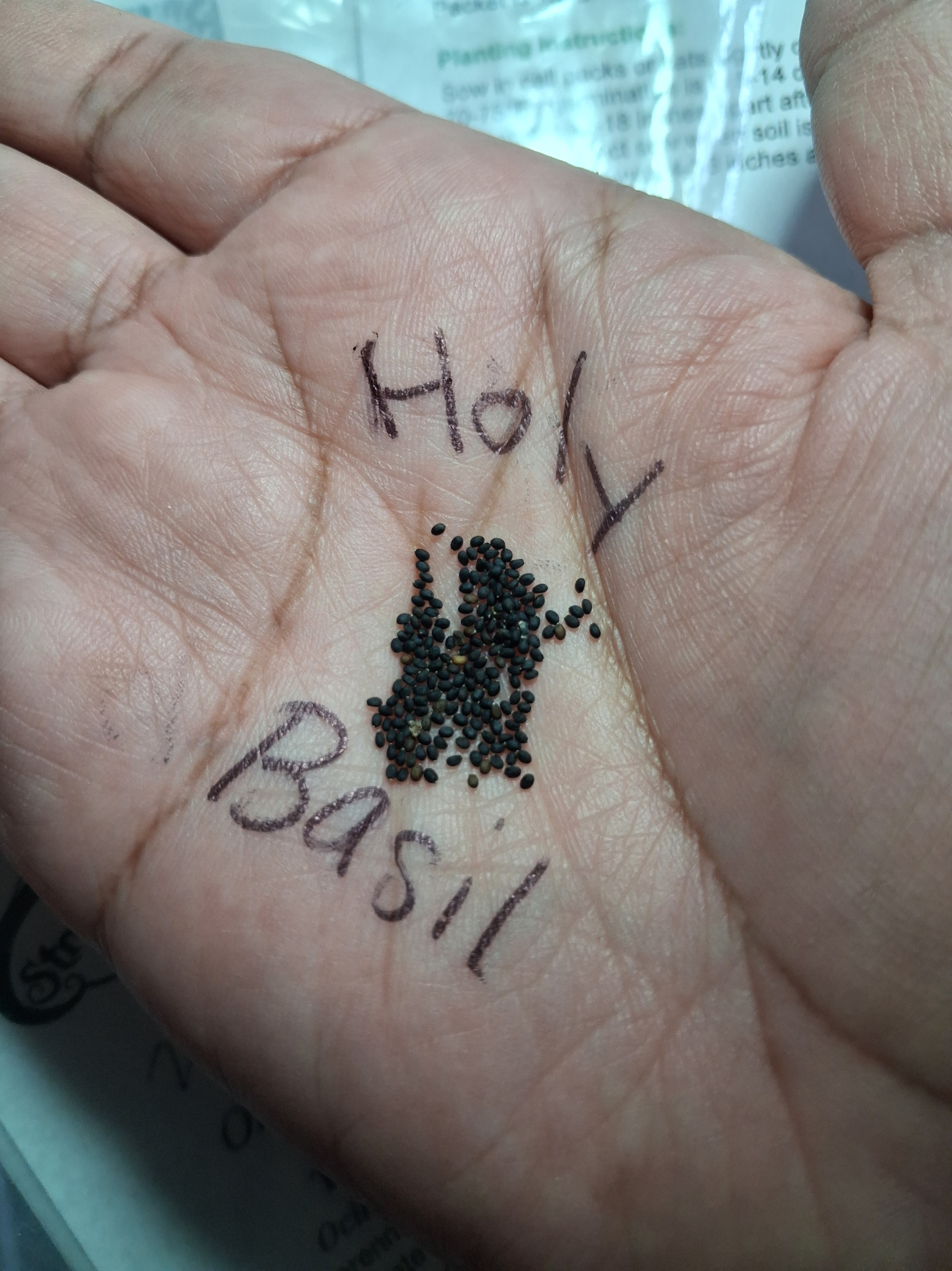
I want to start with holy basil. I have over 20 varieties from different sources. Going to run viability tests and seed starts. Basil is my favorite herb. I make fresh pesto with it and even have it in my tea when I want to relax. It reminds me of female rains that come in the spring. Imagine the smell of wet sand refreshing the air.
Basil List: Sacred Organic Basil (California), Tulsi, Rama (Oregon), Holy Basil (Idaho), Red Rubin Basil (Utah), Holy Basil (Arizona), Diredawa Basil (Minnesota), African Nunum Basil (Missouri), Genovese Basil (Johnny’s Selected Seeds), Mrs. Burn’s Lemon Basil (Iowa), Lemon Basil I (New Mexico), Lemon basil II (New Mexico), Tulsi Sacred Basil (New Mexico), Purple Basil (Johnny’s Selected Seeds), Opalescent Basil (Philomath, Oregon), Italian Genovese Basil (Botanical Interests), Lemon Basil (Seedsaver’s Exchange), Italian Large Leaf Basil (Johnny’s Selected Seeds), Italian Large Leaf Basil (Great American Seed Up), Mrs. Burn’s Lemon Basil (Johnny’s Selected Seeds), Purple Dark Opan Basil (Seed Savers Exchange), Basil Napoletano (Botanical Interests), Italian Mountain Basil (High Desert Seed), Lime Basil (Botnical Interests).
Time Frame: Seed Viability Tests: 4/27/2026 to 5/11/2026
Discover more from Bimá Nahalin
Subscribe to get the latest posts sent to your email.
