Reviewed by Karyn Denny
Marcella LaFever’s article, Empowering Native Americans: Communication, Planning, and Dialogue for Eco-Tourism in Gallup, New Mexico, focuses on a community planning project to expand an existing hiking trail into an eco-friendly loop trail around Pyramid Peak in Gallup, NM (134). This unique effort involved representatives from local governments and agencies, as well as the Churchrock Chapter House, a local intergovernmental branch within the Navajo Nation. These representatives came together to devise a plan that would help “replace a culture of exploitation” (134). The culture of the indigenous people in Gallup has been exploited by tourist businesses for many decades, and now there’s a lot of interest from the community to put an end to it.
LaFever entered the planning process to “conduct a communicative assessment,” during which she interviewed participants, reviewed her findings, and developed recommendations for the community regarding the Pyramid Peak project (134). LaFever identified three strategic communication theories of public dialogue: communicative action, insurgent historiography, and spatial production (130). In dealing with this kind of situation, each theory focuses on public participation as an opportunity for public dialogue and meaning-making for marginalized communities (130-131).
Background of Gallup, NM:
LaFever calculated the percentage of the population to show diversity in Gallup. The population included the Navajo Nation, the Hopi, the Zuni, and the Laguna Pueblos. LaFever calculated that 37% were Navajo and White, 45% were 45%, and 35% were Hispanic/Latino (133). LaFever also recognized the community’s unique government structure: the McKinley County Council, the City of Gallup (COG), and the Churchrock Chapter House, all of which played significant roles in the public planning process (133).
Communicative Action: Engaging All Voices:
LaFever’s communicative action approach emphasizes that community members can speak openly in a designated space for a set period of time. LaFever used Habermas’s theory of communicative action, which holds that “citizens have equal opportunity and equal voice,” and, in this case, the Gallup community members were given “time and space” to discuss their difficulties with “exclusion and exploitation” within their community (131).
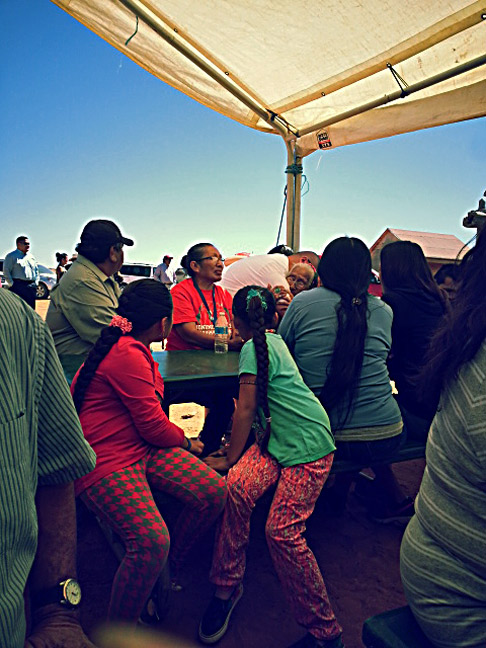
Meetings were held several times at various locations in and around Gallup, giving community members an opportunity to speak. At one meeting, LaFever mentioned how a non-native speaker told her to give the microphone to a Navajo after he spoke. LaFever immediately assumed that there were dominant and non-dominant members among the community members in the meeting. LaFever called this situation a “counter public enclave,” in which community members with a history of clashing operate in a certain way to “avoid negative actions towards themselves” (136). When this happens, good relations are not formed, but they become separate and distinct cultures and/or groups (136).
Insurgent Historiography: A Stand Against Oppression:
The second theory that LaFever focuses on is insurgent historiography, which was developed from a postcolonial perspective that stresses the need “to have knowledge, understanding, and act against oppression and powerlessness in the context of colonialism” (132). LaFever asserts that this theory can empower marginalized groups, such as the indigenous community in Gallup, and help them reclaim and sustain their culture by taking it back and learning to withdraw from participating in, and/or putting up with, the exploitative practices businesses use to boost tourism in Gallup. LaFever stated that marginalized communities need to be educated about their oppression in order to gain empowerment and use resistance to suppress the exploitation of their culture (132). These groups also need to think critically about their oppression and make effective decisions to help them escape their situation.
LaFever recognized that the Churchrock Chapter House meetings needed to be given higher priority in their planning process, since they were at the center of contention, and that insurgent historiography would be ideal for this process (137). From the meetings at the chapter house, LaFever learned that there were previous efforts “by Native Americans to empower themselves,” but they were not successful as the commodification of the indigenous cultures was deeply rooted in the community, which made it difficult to form a strong resistance against cultural exploitation (137).
LaFever provided an example in which a business owner stated that he wanted to hire young Navajo men and women who were friendly and would wear their traditional clothing to work, greet tourists, dance for them, and act as ambassadors for their people (137-138). It is clear that businesses that cater to tourists are exploiting and profiting from the labor and culture of the Navajo people. LaFever gathered data on these instances, which helped her to question whether the Pyramid Peak project was for local residents or visitors (138). Based on her findings, LaFever felt that the Navajo community needed to be taken more seriously by the dominant community. LaFever stated that she met a man who felt that sidewalks in Gallup served the community, whereas a hiking trail outside the community didn’t serve the community but did serve visitors and/or tourists (138).
Spatial Production: The Trail Interferes with the Navajo Land Trust Relationship:
LaFever’s third theory, called spatial production, is useful when making important decisions about the community’s needs. Spatial production was used in the Pyramid Peak project to determine whether the hiking trail loop would be appropriate for the community. LaFever learned that the County of Gallup wanted to “develop a tourism plan” that would use the whole county, but the Navajos became concerned when it involved crossing onto their land, and so boundaries became an issue (138). LaFever realized there were two different views about land: Navajos felt the trail should not go onto their land, and the COG couldn’t understand why. LaFever discussed how Navajo Allottees hold land in a trust relationship with the U.S. government, and it is not up to them to decide who can use the land. For COG to create a trail on Navajo land, it would need to obtain approval from the Department of the Interior and meet specific criteria (139). It was clear that the 300 Allottees chose to keep their land off-limits and available only for sheep and grazing. LaFever stated that the Navajos valued their land and their non-consent to build a trail that went through their land was their “continued struggle to appropriate, use, dominate, control, and produce their own space” (139).
Conclusion:
Ultimately, the Pyramid Peak Project didn’t go through, but it was an important opportunity for representatives from local governments and agencies, and the Churchrock Chapter House, to meet and listen to community members in Gallup. Dominant and non-dominant voices were heard, and I believe that everyone involved learned how to speak in a public dialogue. The Navajo people in the community were able to gather, speak their minds, regain their empowerment, and resist the construction of a trail on their land. The dominant community members were able to see the problems they create for the indigenous community, and they learned the importance of space (boundaries) and the need to rethink how they view the diverse community in Gallup. They also need to consider changing their business tactics in a way that doesn’t exploit and hurt the indigenous community. All three theories suggest that community members need to meet and participate in their community’s economic development planning. Non-dominant (marginalized) communities need to learn about their oppression and gain empowerment so that they learn how to resist further oppression. Lastly, space is viewed differently in indigenous communities, so more research is needed to understand how to work with communities like Gallup so that everyone benefits.
Source:
LaFever, Marcella. “Empowering Native Americans: Communication, Planning, and Dialogue for Eco-Tourism in Gallup, New Mexico.” Journal of International and Intercultural Communication 4, No. 2 (May 2011): 127-145.
